
Four-Wheel Garden Rover with a Mower Deck and Watering Turret
A four-wheel garden rover combines a height-adjustable mower, hose-fed watering turret, wheel encoders, and inertial sensing on a flexible chassis.
Overview
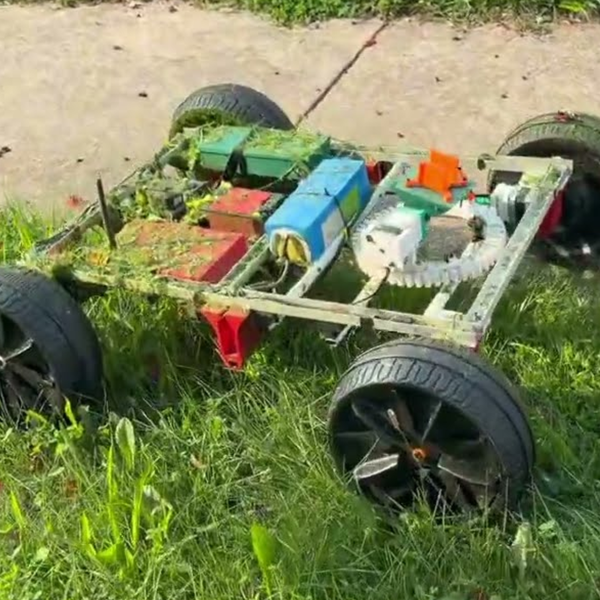
This outdoor robot combines mowing and targeted watering on one platform. Four motorized wheels carry a mower deck beneath an aluminum chassis, while a motor-driven turret aims a nozzle supplied by a trailing garden hose. A rope-driven lift changes the deck height, and a separate flow controller switches the watering system.
Wheel encoders and a nine-axis inertial sensor provide feedback for motion estimates. The main controller coordinates movement, mower commands, and turret operation, with phone, handheld, and voice interaction described as control options. Navigation from these sensors is dead reckoning, so wheel slip and accumulated heading error still matter.
The chassis uses its own flexibility to accommodate uneven ground. The battery sits low in the structure, electronics occupy protected boxes, and the hose connection avoids the weight of an onboard tank. Mechanical clearances and cable routing are central to making all three functions coexist.
Parts
This parts table is seeded from the Blueprint project.
| Part function | Canonical name | Qty | Type | Size | Est. cost |
|---|---|---|---|---|---|
| Wheel Motor (Front-Left, Front-Right, Rear-Left, Rear-Right) | Geared DC Drive Motor (exact model undocumented) | 4 | Actuator | 100x37x37mm | $100.00 |
| Rover Power Battery | High-Discharge Battery Pack (voltage and model undocumented) | 1 | Power | 160x75x55mm | $85.00 |
| Grass Mower Motor | C6374 3000W Brushless Outrunner Motor | 1 | Actuator | 74x63x63mm | $75.00 |
| Mower Motor Controller | High-Current Brushless ESC (exact model undocumented) | 1 | Module | 100x70x25mm | $65.00 |
| Drive Wheel (FL, FR, RL, RR) | 10-Inch Pneumatic Utility Wheel | 4 | Mechanism | 254x254x80mm | $60.00 |
| Main Rover Controller | ESP32-P4-Function-EV-Board | 1 | Controller | 85x54x15mm | $55.00 |
| Flexible Chassis Pan | 5052-H32 Aluminum Sheet | 1 | Structural | 700x500x3mm | $42.00 |
| Mower Height Lift Motor | NEMA 17 Planetary Geared Stepper Motor | 1 | Actuator | 100x42x42mm | $35.00 |
| Turret Worm Gearset | NEMA17 40:1 Worm Gear Reducer | 1 | Mechanism | 90x70x65mm | $32.00 |
| Wheel Encoder (Front-Left, Front-Right, Rear-Left, Rear-Right) | Quadrature Wheel Encoder (exact model undocumented) | 4 | Sensor | 37x37x8mm | $32.00 |
| Upper Equipment Deck | 5052-H32 Aluminum Sheet | 1 | Structural | 500x350x3mm | $25.00 |
| Garden Hose Flow Valve | Normally-Closed Electric Water Valve (exact model undocumented) | 1 | Actuator | 85x60x45mm | $22.00 |
| Mower Deck Guard | Round Galvanized Steel Drain Pan | 1 | Enclosure | 400x400x80mm | $18.00 |
| Mower Lift Carriage | OpenBuilds V-Slot 20x40 Linear Rail | 1 | Mechanism | 400x40x20mm | $18.00 |
| Watering Turret Motor | NEMA 17 Stepper Motor | 1 | Actuator | 48x42x42mm | $18.00 |
| Main Electronics Box | LeMotech IP67 Waterproof Junction Box | 1 | Enclosure | 200x120x75mm | $17.00 |
| Logic Power Regulator | DC-DC Buck Converter (exact model undocumented) | 1 | Power | 65x35x18mm | $15.00 |
| Rover 9-Axis IMU | 9-Axis IMU Module (exact model undocumented) | 1 | Sensor | 20x16x4mm | $15.00 |
| Metal Blade Hub | C6374 Clamp-Style Aluminum Propeller Adapter | 1 | Mechanism | 60x60x35mm | $14.00 |
| Motor Plate | 6061 Aluminum Plate | 1 | Structural | 180x180x6mm | $14.00 |
| Front Bumper | 6061 Aluminum Angle | 1 | Structural | 500x40x40mm | $13.00 |
| Rear Bumper | 6061 Aluminum Angle | 1 | Structural | 500x40x40mm | $13.00 |
| Mower Controller Plate | 6061 Aluminum Heat Sink Plate | 1 | Structural | 180x120x6mm | $12.00 |
| Mower Cutting Disc | Brush Cutter Trimmer Head Plate | 1 | Mechanism | 250x250x3mm | $12.00 |
| Water Controller Box | LeMotech IP67 Waterproof Junction Box | 1 | Enclosure | 150x100x70mm | $12.00 |
| Turret Slewing Bearing | Lazy Susan Turntable Bearing | 1 | Mechanism | 152x152x12mm | $10.00 |
| Water Flow Controller | ESP32 Development Board (exact model undocumented) | 1 | Controller | 55x28x13mm | $10.00 |
| Cable Glands | PG13.5 IP68 Nylon Cable Gland | 12 | Misc | PG13.5x35mm | $9.60 |
| Chassis Bolts | M6 Stainless Steel Hex Bolt | 40 | Misc | M6x20mm | $8.80 |
| Garden Hose Adapter | GHT 3/4-Inch Brass Swivel Adapter | 1 | Mechanism | 55x32x32mm | $8.00 |
| Mower Lift Rope | 1/8-Inch Dyneema Synthetic Winch Line | 1 | Mechanism | 3000x3x3mm | $8.00 |
| Battery Straps | Heavy-Duty Hook-and-Loop Battery Strap | 2 | Misc | 500x25x2mm | $5.00 |
| Component Screws | M3 Stainless Steel Socket Head Screw | 48 | Misc | M3x12mm | $3.84 |
| Heat-Set Inserts | M3 Brass Heat-Set Threaded Insert | 32 | Misc | M3x5mm | $3.20 |
Estimated total for the modeled parts: $885.44.
How It Works
The power model uses a 48 V battery branch for the brushless mower controller and a step-down converter for the 5 V logic supply. The main controller, flow controller, inertial sensor, and wheel encoders are shown on the logic branch. The drive motors, lift, turret, and valve still require correctly rated driver and supply circuits; they are not all powered by the logic converter.
Each wheel encoder supplies two channels, giving the controller direction and distance information. The inertial sensor communicates over I2C and has a data-ready interrupt. Firmware combines these inputs to estimate motion and commands left and right wheel speeds for differential steering. Exact GPIO assignments and any required level conversion need to be resolved before wiring.
The main controller sends a throttle command to the mower controller and a separate command to the water-flow board. The mower’s power return and the low-level control reference need deliberate routing; a step-down regulator alone does not establish galvanic isolation. Treat the model’s voltage and current annotations as design inputs to verify against the chosen hardware.
Mechanically, the deck moves on a rope lift while the turret uses a high-reduction transmission to hold and aim the nozzle. Hose drag, jet reaction, and chassis flex all influence the motion estimate, so initial drive tests should separate these loads before attempting combined operation.
Build Steps
-
Complete the power and control design. Add the missing bidirectional wheel drivers, lift and turret drivers, valve switching, and suitable protection to the working schematic. Resolve the input logic levels, control assignments, and emergency shutdown behavior before building the harness.
-
Assemble and inspect the chassis. Deburr the aluminum structures, fit the motor brackets, and install the wheels and encoders. Keep structural fasteners accessible, place the battery low, and check that frame flex does not strain a mount or trap wiring.
-
Fit the deck lift and turret mechanically. Check rope tracking and deck travel without powered cutting hardware. Assemble the turret bearings, gears, nozzle support, and hose connection, verifying clearance through the intended range and provision for travel limits.
-
Bring up the logic and sensors. Leave the mower branch disconnected while checking regulated supplies. Spin each wheel by hand to verify its encoder channel and direction, then check inertial readings and the interrupt signal. Label all four wheel harnesses at both ends.
-
Test motion with the cutting hardware removed. Use the completed drivers to exercise wheels, lift, and turret separately at conservative settings. Check loss-of-command and shutdown behavior before testing mower-motor commutation without a blade attached.
-
Finish outdoor routing and check water handling. Route sensor leads away from motor wiring, secure the harness through cable glands, and add strain relief. Check the hose and valve for leaks with electronics protected and confirm that hose pull cannot snag the lift or wheels.
-
Validate the combined platform in stages. Begin with short supervised drive paths and measure return-position error. Verify the guarded cutting assembly, mechanical retention, stopping behavior, and exclusion area before any cutting trial; add watering only after the separate systems behave predictably.
See the complete build steps in Blueprint.
Notes
The largest tradeoffs are hose drag, odometry drift, and chassis compliance. A tank removes the trailing hose but adds mass; improved localization can reduce accumulated error but does not remove the need to detect obstacles and stop reliably. Inspect fasteners and cable clearances after the first ground tests because the frame is intended to flex.
The modeled bill of materials is incomplete around actuator drivers and protective hardware. Its estimated total is not a promise that a working rover can be built for a particular budget, and the annotated mower power does not establish a safe operating limit. Complete the electrical design, guarding, interlocks, and mechanical load checks before using the machine as an autonomous mower. Water-resistant packaging also requires actual sealing and leak checks; it is not established by the enclosure model alone.